 English
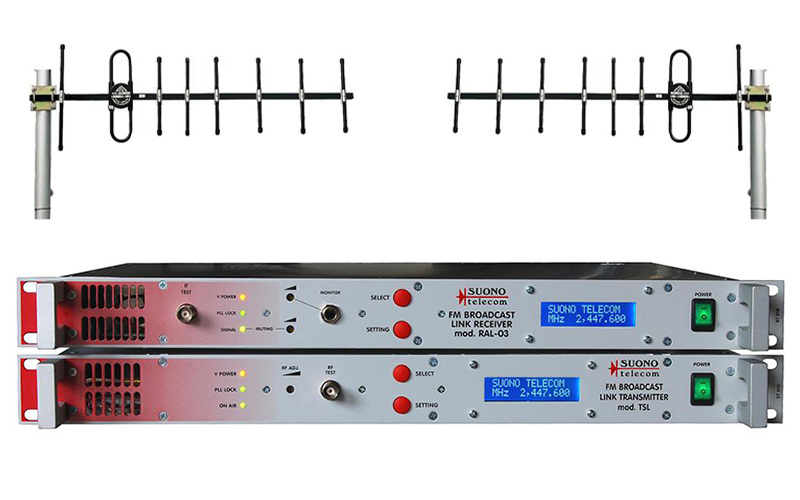
Suono Telecom 48-1100MHz STL delivers a wideband studio-to-transmitter link platform across 48–1100 MHz, giving broadcast engineers flexible VHF/UHF RF paths for reliable audio contribution.
$ 3,041.00 $ 3,607.00
The Suono Telecom 48-1100MHz STL audio link is designed as a versatile RF radio link platform to connect studio locations to remote transmitter sites over VHF and UHF bands. Covering a very wide 48–1100 MHz range, it allows engineers to select suitable channels according to local spectrum plans, interference conditions and regulatory constraints. This flexibility makes the Suono Telecom 48-1100MHz STL a useful backbone for regional FM networks, backup links and contribution feeds where fiber or IP connectivity is limited or unavailable.
This wideband STL platform is typically implemented with synthesized RF modules, providing frequency agility with fine step sizes and stable operation over time and temperature. Paired link transmitters and receivers in this band normally feature robust front-end filtering, good sensitivity and high immunity to spurious signals, ensuring dependable point-to-point performance even in crowded RF environments. When engineered with appropriate antennas, surge protection and grounding, the Suono Telecom 48-1100MHz STL can form part of a protected RF strategy with diversity paths and redundant equipment at key sites.
STL audio links in the 48–1100 MHz range are typically used to carry baseband audio or MPX composite signals from the studio to FM transmitter locations, preserving audio quality and stereo separation. Configurations are available to interface with analog audio, balanced studio outputs or MPX feeds from audio processors, giving broadcasters freedom to keep processing at the studio or at the transmitter site. Typical applications for the Suono Telecom 48-1100MHz STL include primary studio-to-transmitter links, regional contribution circuits, backup paths for critical FM services and point-to-point links where microwave or IP radio solutions are impractical.
For similar wideband STL requirements, broadcasters may also consider synthesized STL transmitters and receivers in the 170–490 MHz and 820–960 MHz 10 W bands, which provide agile RF links in narrower sub-bands for licensed FM contribution paths.
Another alternative is the Wavenet RS-5000 radio-link receiver, a multi-channel base receiver with programmable channels and high sensitivity that can partner with suitable STL transmitters in the same RF band for complex sites.
Complete STL sets such as 20 W MPX or stereo packages including matched VHF/UHF antennas are available when a turnkey studio-to-transmitter link with preselected components is preferred.
Engineers planning multiple studio-to-transmitter paths, microwave hops or backup routes can also review the full STL links category to match system design, redundancy and coverage requirements.