
[language-switcher]
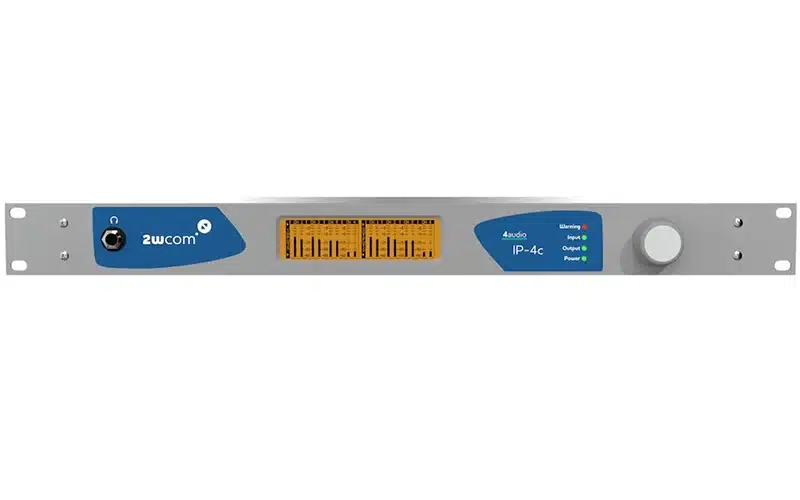
The 2WCOM IP-4c Audio over IP Codec is a professional multi-channel STL codec delivering reliable, low-latency Audio over IP transport with redundant streaming and flexible formats for studio-to-transmitter links.
$ 2,434.00 $ 2,557.00
The 2wcom IP-4c is a professional Audio over IP codec designed for reliable multi-channel audio transport in demanding broadcast environments. It offers flexible I/O, redundancy options and wide interoperability, making it suitable for studio-to-transmitter links, studio backbones and contribution networks.
Up to 4 full-duplex audio channels (model dependent), supporting individual configuration per channel for codec, bitrate and network settings.
Multiple audio formats including uncompressed PCM and common broadcast codecs such as AAC variations and MPEG Layer II, allowing you to balance audio quality and bandwidth.
Redundant streaming options with support for dual streaming, redundant networks and forward error correction to ensure high availability over IP links.
Comprehensive interface options typically including analog and digital audio I/O, GPIOs for control, and management via web interface and SNMP for easy integration into existing infrastructures.
Support for standard protocols and formats used in broadcast IP audio transport, helping interoperability with common STL and AoIP equipment from other manufacturers.
Studio-to-transmitter links where stable, low-latency audio delivery is critical for FM, DAB or other broadcast services.
Contribution circuits between regional studios, remote sites and central facilities, enabling flexible routing and backup paths.
Audio distribution within broadcast or corporate audio networks that require centralized monitoring and control of multiple codecs.